Client: Sculpture by the Sea
Location: Cottesloe, WA
After a year away, Sculpture by the Sea Cottesloe returned in 2026, and Partridge was again involved as both a sponsor and a member of the engineering review team supporting the event.
Partridge participated from the early planning stages through to the final inspection prior to opening. Through the Structural Engineering Review Panel, our role is to work with the exhibition organisers, artists and installers to review each proposed artwork from a structural perspective. This includes assessing safety, stability, material behaviour, installation methods, environmental exposure and the likelihood of public interaction. The aim is to help ensure the artworks can be realised safely while preserving the intent of each artist.
In the lead up to the exhibition, Partridge carried out engineering reviews for a number of installations across the Cottesloe foreshore. These reviews involved structural analysis, consideration of wind loading and site conditions, and discussions with artists about construction, anchorage and installation.
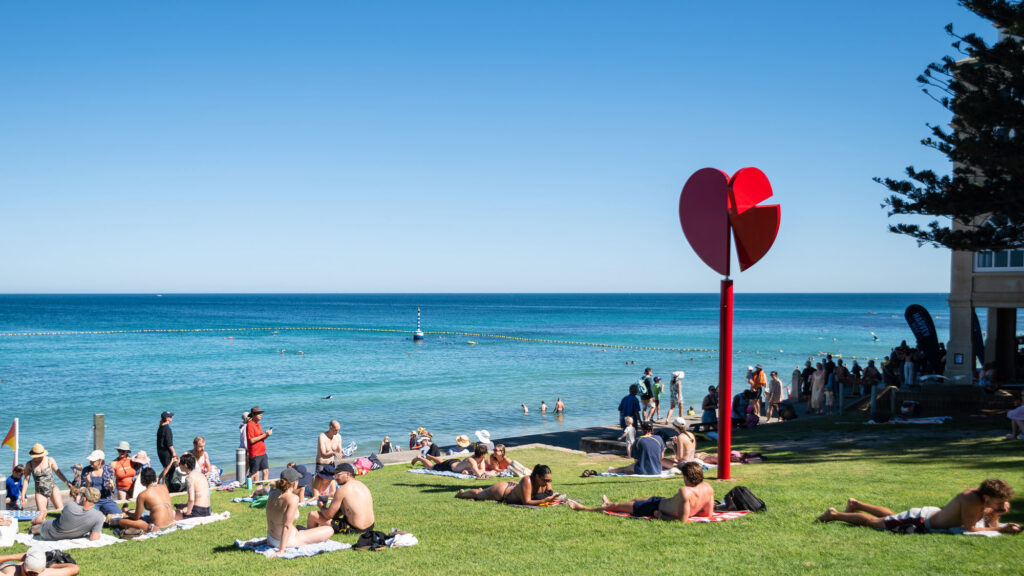
Simon Harris’s kinetic artwork Cuore Bello (pictured above) comprises four aluminium framed segments clad in red panels that together form the outline of a love heart. Each segment is mounted on bearings and designed to rotate independently in the wind. The structural review focused on verifying the capacity of the central mounting pole and the aluminium framing under wind loading while also considering the additional forces introduced by rotation. Although the geometry appears simple, the structure required careful analysis to ensure the moving components remained stable in an exposed coastal environment.
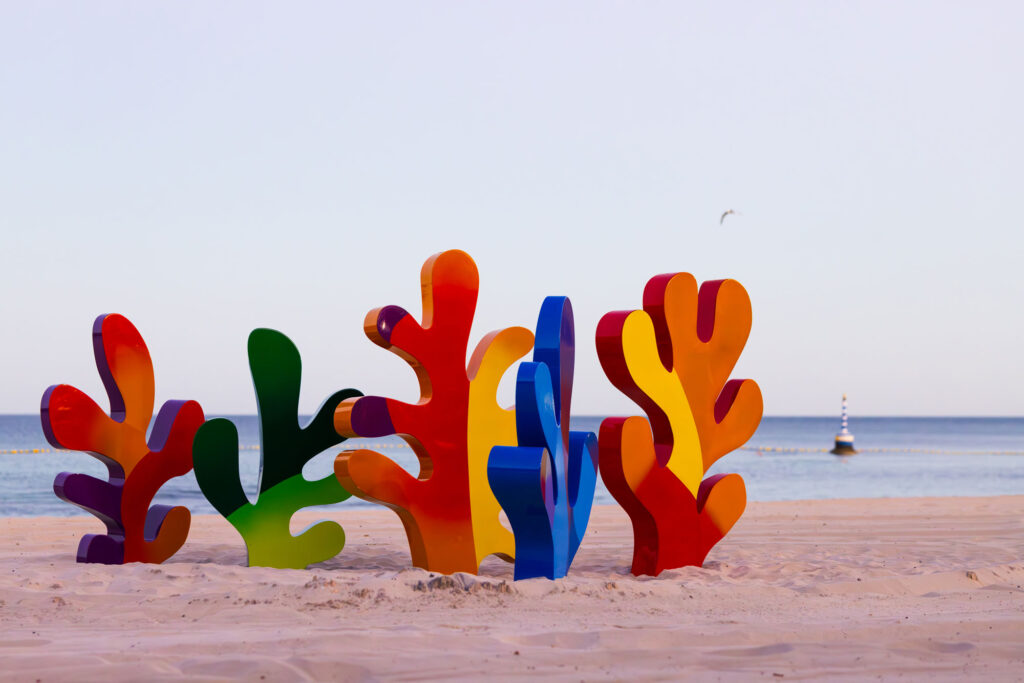
Reef Reverie, (pictured above) created by Rockefeller Studios, forms a brightly coloured forest of coral-like elements that visitors can walk between. The installation invites people to move through the work in a way that reflects the experience of swimming through a reef. Structurally, each coral form is a free-standing element clad around a central steel post. The engineering review considered wind loading on the individual forms and the capacity of the small buried concrete footings required to stabilise them within the sandy site conditions.
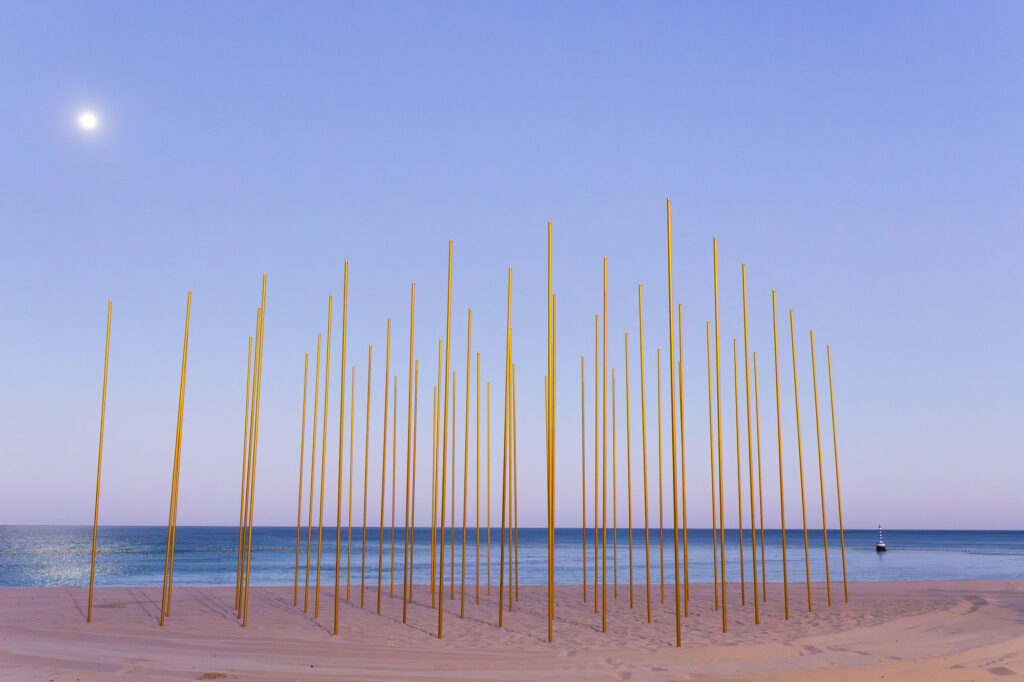
Anton Lord’s installation Golden Fields (pictured above) is a large-scale immersive work consisting of forty-nine slender tubes that move gently in the wind, echoing the motion of seagrass along the coastline. Although the installation appears light and flexible, the tubes project approximately 6.2 metres above ground. Stability is achieved by extending steel pickets deep into the ground, with the pickets continuing part way up inside the tubes. This arrangement provides the required strength while allowing the elements to move in a controlled manner that reflects the natural behaviour the artwork references.
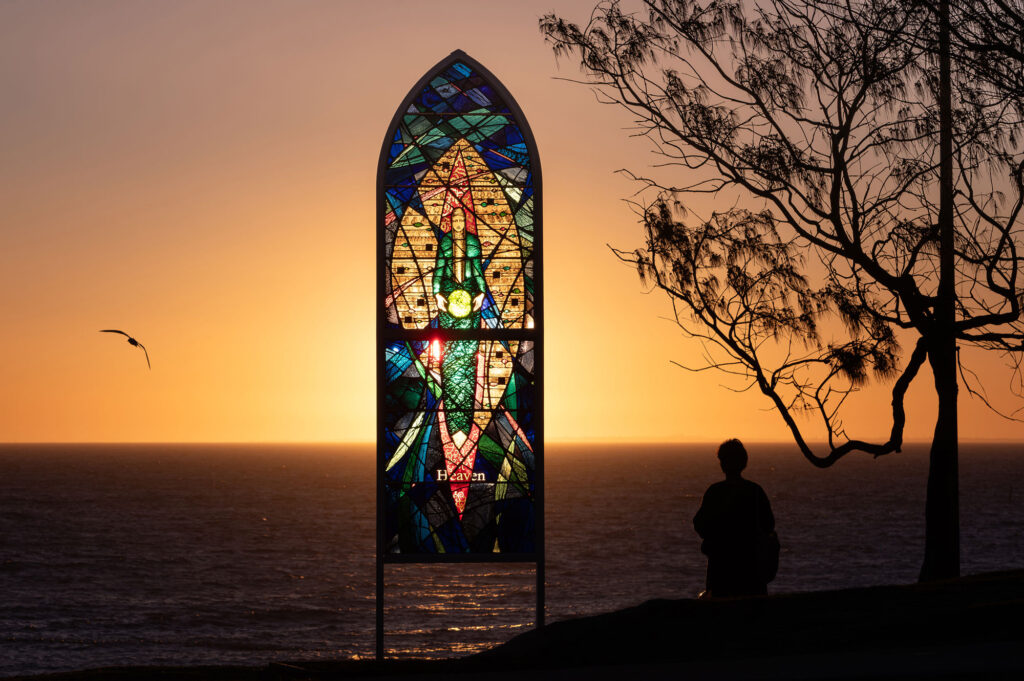
In Heaven is a Place Where Nothing Happens, (pictured above) Vaughn Bisschops presents a contemporary interpretation of stained glass traditions. The work frames a carefully composed image within a large aluminium structure, creating the effect of a floating window. The engineering review focused on the aluminium framing system, its support arrangement and the behaviour of the glazed elements under wind loading, particularly given the exposed coastal location of the exhibition.
Partridge also undertook engineering reviews for artworks by Jason Christopher, Tom de Munk-Kerkmeer, Lucy Humphrey, Kaoru Matsumoto, Drew McDonald and April Pine.
Projects such as Sculpture by the Sea Cottesloe highlight the breadth of structural considerations that arise when artworks are installed in public environments. Temporary installations often combine unconventional forms, lightweight materials and exposed sites. Structural review helps ensure that these works can be installed safely while allowing artists the freedom to explore ambitious ideas.